
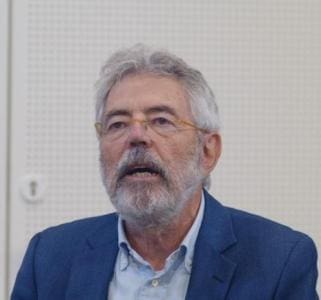
Giulio Sandini is Founding Director of the Italian Institute of Technology and full professor of bioengineering at the University of Genoa. After his graduation in Electronic Engineering (Bioengineering) at the University of Genova he was research fellow and assistant professor at the Scuola Normale Superiore in Pisa until 1984. During this period, working at the Laboratorio di Neurofisiologia of the CNR, he investigated aspects of visual processing at the level of single neurons as well as aspects of visual perception in human adults and children. He has been Visiting Research Associate at the Department of Neurology of the Harvard Medical School in Boston. After his return to Genova in 1984 as associate professor he founded the Laboratory for Integrated Advanced Robotics. In 1996 he was Visiting Scientist at the Artificial Intelligence Lab of MIT.
Since 1980 Giulio Sandini coordinated several international projects in the area of computer vision, cognitive sciences and robotics. He was the initiator of the EU-funded “iCub” project coordinating the activities of the 11 European Research Centers involved in the project RobotCub. The scientific goal of the project was to investigate aspects of human cognition by building an open-source, research-driven, humanoid platform (iCub) to be used by research centers worldwide to study embodied cognition. Since then iCub has established itself as one of the most successful research platform to investigate aspect of cognitive sciences. iCub is used by more than 40 research centers in the world.
Since 2004 Giulio Sandini was involved in preparing the initial Scientific Plan of the newly established Istituto Italiano di Tecnologia (IIT). In 2006 he was selected as one of the first Research Directors of IIT where he established the Robotics, Brain and Cognitive Sciences department. The department’s multidisciplinary research staff is composed of researchers with different backgrounds (engineers, biologists, psychologists, mathematicians, physicists, medical doctors) sharing “human centered” Scientific and Technological interests and addressing four, strictly interconnected, streams of research: Cognitive Robotics; Motor Learning, Assistive and Rehabilitation Robotics, Dynamic Touch and Interaction, Spatial Awareness and Multisensory Integration.